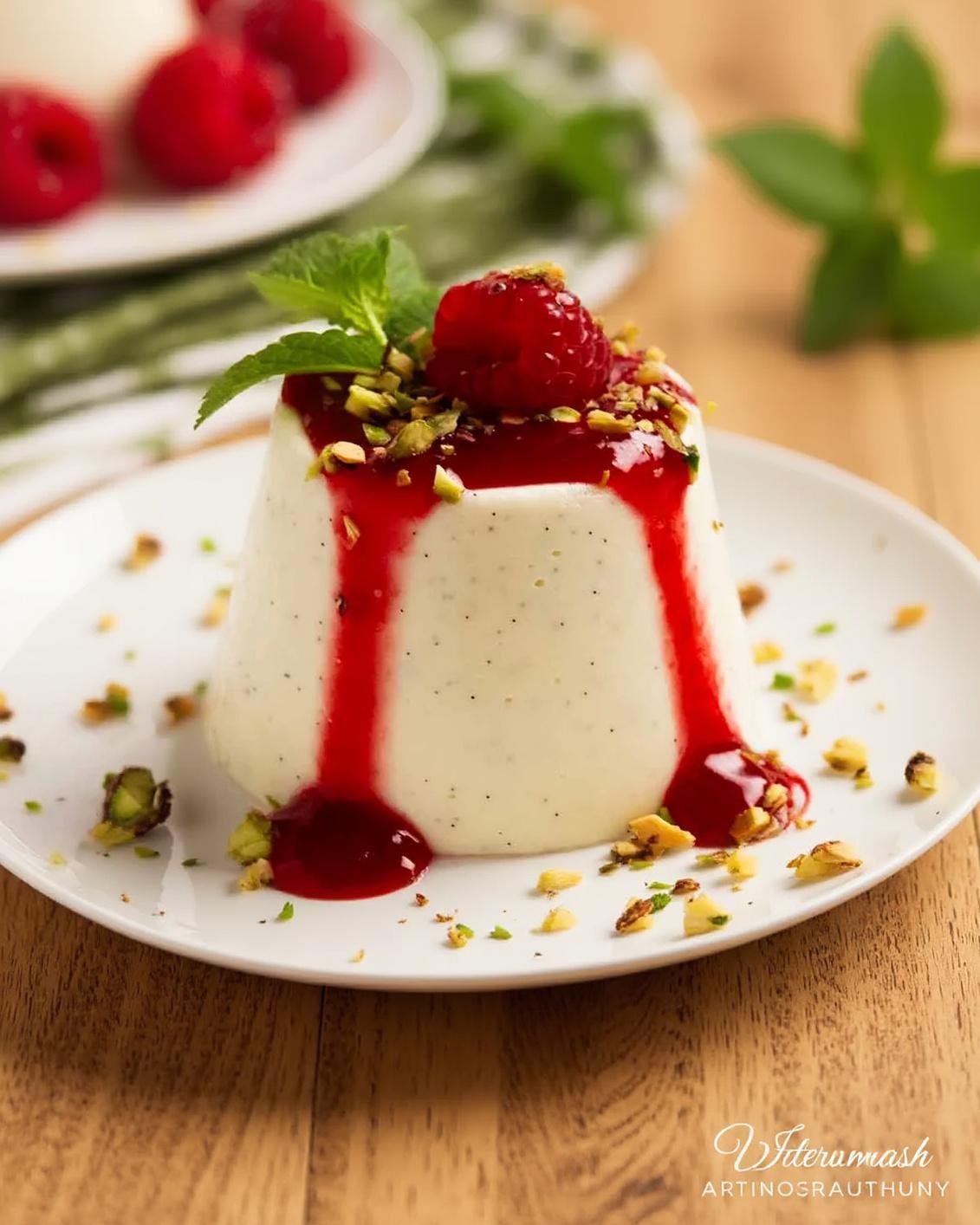
Panna cotta—literally "cooked cream" in Italian—is proof that the best desserts are often the simplest. With just five core ingredients and no baking required, you create something impossibly elegant: a silky, vanilla-scented cream that wobbles enticingly and melts on your tongue.
Unlike custards that require tempering eggs or puddings that need constant stirring, panna cotta is almost foolproof once you understand a few key principles.
Our Classic Panna Cotta Recipe
What Is Panna Cotta?
Panna cotta is a molded Italian dessert made from sweetened cream set with gelatin. Unlike custards (which use eggs for thickening) or puddings (which use starch), panna cotta relies solely on gelatin for its distinctive texture.
The result is lighter than custard yet more substantial than mousse—a perfect wobble that holds its shape when unmolded but surrenders instantly to a spoon. Its neutral vanilla base makes it an ideal canvas for countless flavor variations and toppings.
Key Ingredients Explained
Gelatin: The Structure
Gelatin is what transforms liquid cream into silky solid. Use unflavored gelatin powder (Knox is the most common brand) or gelatin sheets.
Conversion: One packet (2½ tsp) powdered gelatin = 4 gelatin sheets = sets 2 cups liquid.
Important: Gelatin must be "bloomed" in cold water first. This softens it so it dissolves evenly when heated. Skip this step and you'll get grainy panna cotta with undissolved gelatin specks.
Gut Health Bonus
Gelatin contains amino acids like glycine and proline that support gut lining integrity. Some studies suggest it may help heal "leaky gut." For maximum benefits, use grass-fed gelatin which has a better amino acid profile.
Cream and Milk: The Body
The ratio of cream to milk affects richness and texture:
- All cream: Ultra-rich, very decadent, almost too heavy
- 2:1 cream to milk (our recipe): Classic balance—rich but not cloying
- 1:1 cream to milk: Lighter version, still silky
- More milk than cream: Lighter still, but may feel less luxurious
Use full-fat products. Low-fat substitutes won't produce the same silky texture.
Vanilla: The Flavor
A vanilla bean produces the best flavor—you can see the seeds speckling the cream. If using extract, choose pure vanilla extract, not imitation. Add it after heating the cream to preserve the volatile flavor compounds.
Step-by-Step Technique
1. Bloom the Gelatin
Sprinkle gelatin evenly over cold water in a small bowl. Let stand for 5-10 minutes until it absorbs the water and becomes spongy. Don't stir—just let it sit. The gelatin will wrinkle and solidify into a soft mass.
2. Heat the Cream (Don't Boil)
Combine cream, milk, sugar, and vanilla bean in a saucepan. Heat over medium, stirring occasionally, until the sugar dissolves and small bubbles appear around the edges. Do not let it boil—boiling can weaken the gelatin's setting power.
3. Dissolve the Gelatin
Remove cream from heat, add the bloomed gelatin, and stir continuously for 2 minutes until completely dissolved. No lumps should remain. If using vanilla extract instead of a bean, add it now.
4. Pour and Chill
Divide mixture among ramekins or glasses. Let cool to room temperature (about 20 minutes) before covering and refrigerating. This prevents condensation from forming on the surface.
Chill for at least 4 hours, preferably overnight. The panna cotta should wobble when gently shaken but hold its shape.
Troubleshooting Common Problems
Problem: Panna Cotta Didn't Set
Causes:
- Gelatin wasn't bloomed properly
- Gelatin was added to boiling liquid (which destroys its setting power)
- Not enough gelatin for the liquid volume
- Didn't chill long enough
Fix for next time: Bloom gelatin for the full 5-10 minutes, add to warm (not boiling) cream, and chill overnight.
Problem: Too Firm/Rubbery
Too much gelatin makes panna cotta bouncy rather than silky. Reduce gelatin by ½ teaspoon next time. Perfect panna cotta should barely hold its shape—more like a tender wobble than a firm jelly.
Problem: Grainy Texture
Undissolved gelatin causes graininess. Ensure the gelatin is fully bloomed (should be uniformly soft with no dry spots) and stir continuously when adding to the warm cream until completely dissolved.
Flavor Variations
Panna cotta's neutral base welcomes countless flavors:
- Coffee: Add 2 tbsp instant espresso to the warm cream
- Chocolate: Whisk 3 oz melted dark chocolate into warm cream mixture
- Coconut: Replace milk with coconut milk; top with toasted coconut
- Lemon: Add 2 tbsp lemon juice and 1 tbsp zest after heating
- Lavender: Steep 1 tbsp dried lavender in warm cream, strain before adding gelatin
- Matcha: Whisk 1 tbsp matcha powder into the cream mixture
- Rose: Add 1 tsp rose water and a drop of pink food coloring
Perfect Toppings
The right topping elevates panna cotta from simple to spectacular:
Fresh Fruit
Berries are classic—their tartness cuts through the cream's richness. Try:
- Mixed berries with a mint sprig
- Sliced peaches or nectarines in summer
- Passion fruit (cut in half and scoop seeds directly over)
- Figs with a drizzle of honey
Sauces
- Berry coulis: Blend berries with a little sugar, strain out seeds
- Caramel: Salted caramel is especially good
- Chocolate: Warm ganache or chocolate sauce
- Espresso: Pour a shot of espresso over for affogato-style
Textural Additions
- Crushed amaretti or biscotti
- Toasted nuts (almonds, pistachios, hazelnuts)
- Granola for breakfast panna cotta
- Candied citrus peel
Make-Ahead Tips
Panna cotta is the ultimate make-ahead dessert:
- 3 days ahead: Make and refrigerate, covered. Texture actually improves with time.
- Day of serving: Add toppings no more than 2 hours before serving to prevent sogginess.
- To unmold: Dip ramekin in hot water for 5 seconds, run a thin knife around the edge, invert onto plate. If it won't release, dip again briefly.
Serving Tip
Not confident in unmolding? Serve panna cotta directly in pretty glasses or jars with sauce and toppings layered on top. It's just as elegant and completely stress-free.
The bottom line: Panna cotta proves that elegant doesn't have to mean complicated. With just five ingredients, minimal hands-on time, and the ability to make it days ahead, it's the perfect dinner party dessert. Master the basic vanilla version, then experiment with flavors and toppings to make it your own. The silky texture and beautiful presentation will have guests convinced you spent hours in the kitchen—only you'll know the truth.